The Finished Picture
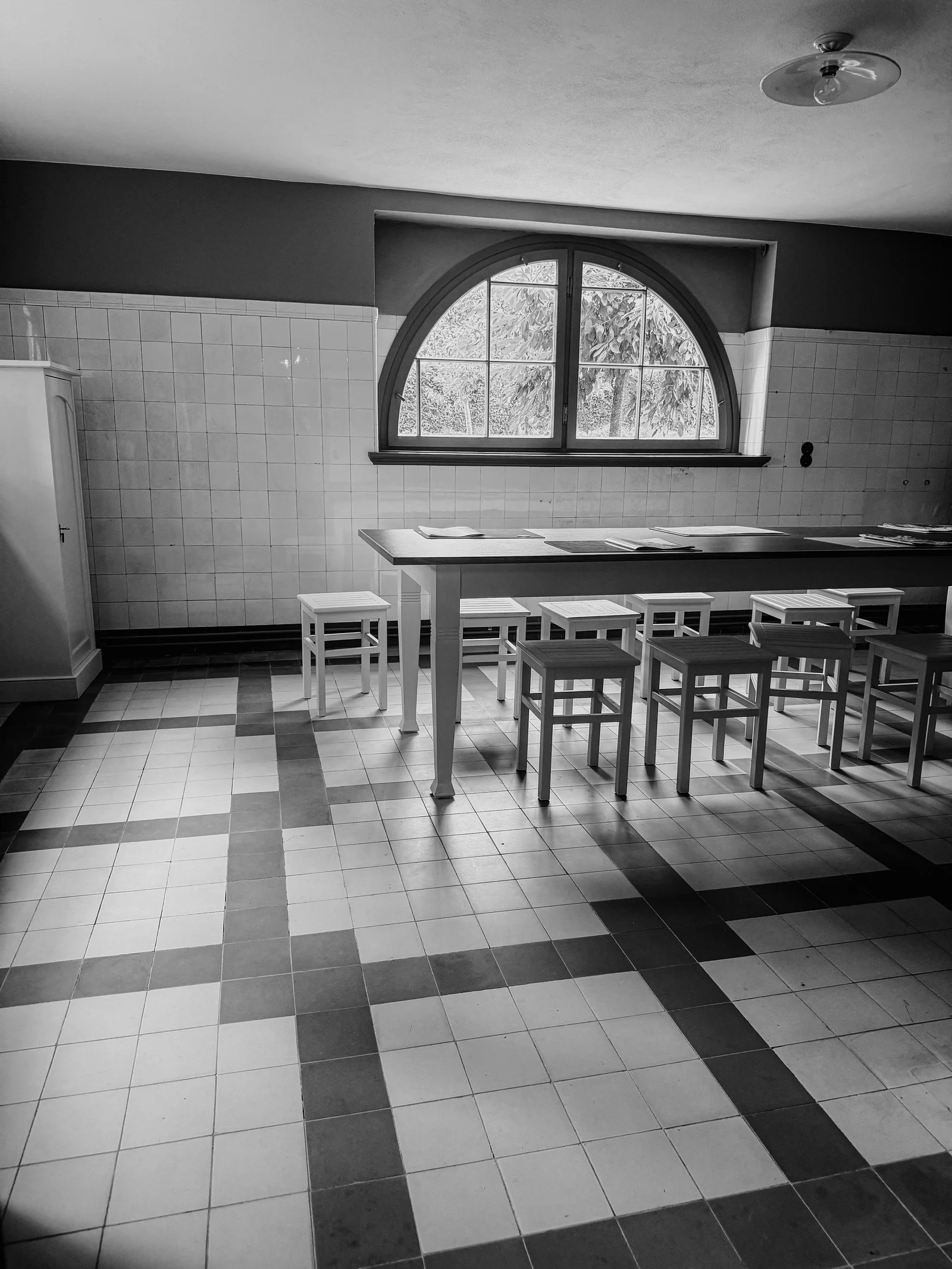
Yesterday I stood in the basement of the Dehmel-Haus in Hamburg-Blankenese, looking at a small exhibition about two people I knew almost nothing about. Richard Dehmel: a poet, famous around 1900, set to music by Strauss and Schoenberg. That was the extent of my knowledge, and it turned out to be enough. Enough, at least, to sort him within thirty seconds. Glass cases, photographs, letters. Ah, I thought: the usual avant-garde of the early century. Well-connected, art-loving, comfortably bourgeois.
The exhibition kept confirming it. Ida Dehmel: suffragette before there was a vote to cast, salonière whose fifty thousand letters connected half of literary Europe, founder of GEDOK in 1926, a network for women artists that is still working today. Every glass case added a piece to the picture I had already painted. Progressive power couple, ahead of their time. The file grew thicker and more comfortable.
Then I saw the portrait of Richard Dehmel in uniform. He volunteered for the front in 1914, at fifty-one. Not a poet with a desk job in the propaganda office: infantry, western and eastern front, two years, wounded, home. He came back disillusioned and still called on Germany to hold out in 1918, loudly enough that Käthe Kollwitz contradicted him in public. In 1920 the war finished the job in this house, one floor above where I was standing, in the form of a vein inflammation he had carried home from the trenches.
A few minutes later the tour guide added, almost in passing, that what surprises many of her visitors is this: by today’s standards, both Richard and Ida would be classified as conservative, and not necessarily as left at all.
That sentence hit harder than the portrait. It revealed that the file itself was the error. I had spent an hour adding true details to a false picture, and the details never protested; details don’t. They tell the full story only if you let them, and I hadn’t been letting them. I had been using them as decoration for a story I’d finished in the first thirty seconds.
The temptation at this point is to say the Dehmels were full of contradictions. But that’s the machine talking again. A contradiction requires a rule about what goes together, and the rule is the thing that didn’t exist yet. Workers’ rights and Kaiser loyalty, erotic poetry and a blasphemy trial and a proper bourgeois household, suffrage and salon and nation: in 1905 these were positions a person could hold one by one, on their merits, the way you might hold opinions about wine. The package deal came later. The idea that your stance on gender predicts your stance on the nation predicts your stance on art is an invention, and it has a construction date. The Dehmels lived before the factory opened.
Jens Spahn resigned five weeks ago.
He resigned because he and his husband had a child, carried by a surrogate in the US, and because surrogacy is banned in Germany, and because he had defended that ban as a politician for years. The commentary sorted itself within hours: hypocrisy on one side, witch hunt on the other. Both readings miss the more uncomfortable question, which is why the honest sentence was never available to him. Imagine Spahn in 2020: I am conservative, I believe in family, commitment, responsibility, and my husband and I want a child, which for us means a surrogate. Nothing in that sentence is incoherent. It’s roughly how the Dehmels lived, position by position, each on its own merits. But the sentence is unsayable in his party, because the sorting machine has assigned “gay father via surrogacy” to the other team. So he hid his own life from his own politics until it detonated. The culture war didn’t catch a hypocrite. It manufactured one.
This isn’t a story about conservatives. The left runs the same machine, pointed inward: the coalition that should be unionizing around housing, wages and climate spends remarkable energy verifying its own members’ complete conformity to the bundle. Meanwhile the AfD grows, month after month, and one reason is depressingly simple. It’s the only party telling people they don’t have to pass an entrance exam. That’s a lie, of course; its bundle is the most rigid of all. But it’s a lie aimed precisely at everyone the other machines have rejected.
The AfD’s appeal runs on the same mechanism as my thirty seconds in the basement, scaled up and made permanent. Simple pictures for complicated things, and the promise that the details won’t be needed. It’s no accident that the party wants to end Erinnerungskultur; memory culture is nothing more than the organized refusal to let the details disappear, and details are what a simple picture cannot survive. But complexity doesn’t vanish when you abstract it away. It hides, it waits, and it bites when you’ve forgotten it’s there.
The last people who can say “I was there” are dying. After them, the past has exactly two voices left: the simple picture, which prints itself by the million, and the kept detail, which waits in houses like this one for somebody to show up. I showed up by accident and got corrected within an hour, by a portrait, a sentence from a volunteer, and fifty thousand letters I’ll never read. That’s what the correction of a finished picture costs. One visit. The picture, on the other hand, is free.
Further reading:
- Dehmelhaus — The website of the Dehmelhaus Stiftung, which preserves the 1912 artists’ residence of Richard and Ida Dehmel in Hamburg-Blankenese as a protected monument and exhibition space.
- Ida Dehmel at Tsurikrufn! — A portrait of Ida Dehmel on the digital memorial platform for Jewish personalities in German history, contributed by the Institute for the History of German Jews in Hamburg.